
— Self-Directed Brokerage Accounts —
Your 401(k) may have more room than you think.
Some employer retirement plans include a self-directed brokerage account. If yours does, it can open the plan to a wider range of investments and, in some cases, to professional management.
A self-directed brokerage account is a feature inside some 401(k), 403(b), and 457 plans that lets a participant invest beyond the plan's pre-selected menu.
— The definition —
What is a self-directed brokerage account?
A self-directed brokerage account, usually shortened to SDBA, is an option available within some company-sponsored 401(k), 403(b), and 457 plans. It is sometimes called a brokerage window. Where a plan offers one, a participant can invest in more than the pre-selected choices the plan sponsor put on the menu.
The core plan menu is chosen by your employer and the plan's advisers. It is usually a short list. That list may serve you well. It may also leave out categories, managers, or strategies you would want available as you get closer to retirement.
An SDBA sits inside the same plan. The money does not leave your employer's plan and it is not a distribution or a rollover. What changes is the range of what you can hold and, depending on the plan, who is permitted to manage it.
Through a Howard Capital Management (HCM) self-directed brokerage account, participants may also gain access to third-party professional money management, strategies intended to manage exposure during market declines, and a broader set of growth options. Availability depends entirely on your specific plan, and no strategy removes the risk of loss.
— What it includes —
What an SDBA can make available.
Features vary by plan and by provider. Where a brokerage window is offered, participants commonly gain some combination of the following.
- Access to investments outside the plan's core menu, which may include additional mutual funds, exchange-traded funds, or individual securities
- The ability to have a third-party investment manager direct the account, where the plan permits it
- Broader diversification across asset classes and managers
- Continued participation in the employer plan, including payroll deferrals and any employer match
- Ongoing monitoring and periodic rebalancing when a manager is engaged
- Strategies designed to adjust market exposure as conditions change, which may reduce but cannot eliminate the risk of loss
- Coordination between the plan account and the rest of your retirement picture
- A single point of contact for questions about the account
— At a glance —
Three ways a retirement plan account can be handled.
Not every plan offers every option below. The point of the comparison is to show what changes as a participant moves from the default menu toward a professionally managed brokerage window.
Basic company plan
- Access to pre-selected investment options chosen by the plan sponsor
- Limited or no access to personalized advice
- Limited or no access to third-party active management
Basic SDBA
- More control over the retirement plan account, with the possibility of additional investment options
- Potential access to personalized advice
- An option for third-party active management where the plan allows it
- Access to management strategies that may seek to reduce exposure during extended declines
HCM SDBA
- Proactive third-party asset management
- The HCM-BuyLine®, a proprietary quantitative indicator Howard Capital Management uses to inform decisions about market exposure
- Access to a selection of HCM proprietary mutual funds
- Periodic portfolio rebalancing
- Weekly market updates
Howard Capital Management is an unaffiliated third-party investment manager. Third-party management and proprietary funds carry their own fees and expenses in addition to any plan-level costs. No indicator, including the HCM-BuyLine®, can predict future market movements or protect against loss in a declining market.
— Why it matters —
The account grows. The habits usually do not.
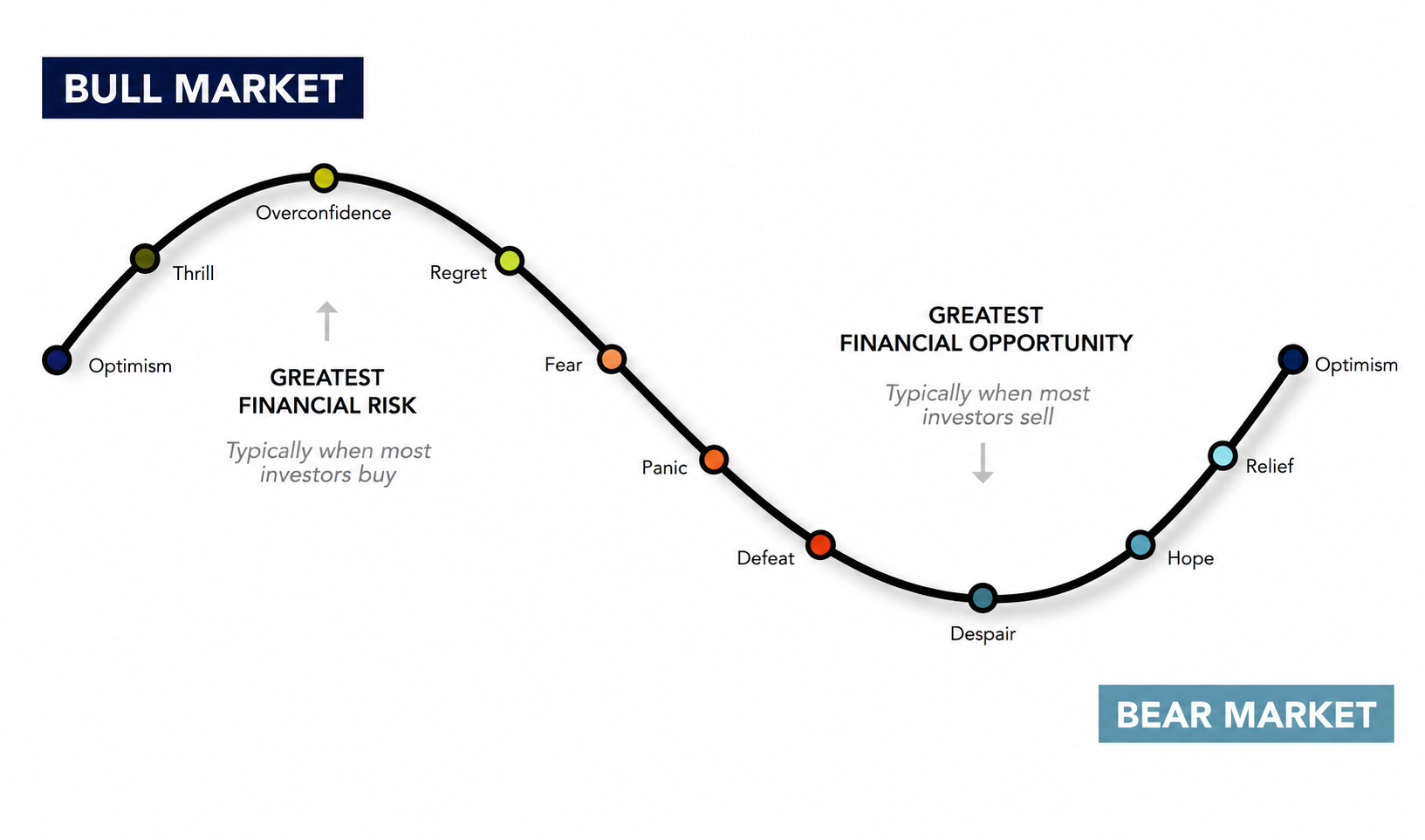
The chart above is not a forecast and it is not a track record. It is a map of behavior, and it is one of the more useful pictures in personal finance.
Read the top of the curve first. Optimism gives way to thrill, and thrill to overconfidence. That peak is labeled the point of greatest financial risk, because it is typically when the most money moves in. Prices are high, confidence is high, and adding feels obvious.
Now read the bottom. Regret becomes fear, fear becomes panic, and panic becomes defeat and despair. That trough is labeled the point of greatest financial opportunity, because it is typically when the most money moves out. Prices are low, confidence is gone, and selling feels obvious.
Neither instinct is a character flaw. Both are ordinary. The difficulty is that a retirement plan account is often the largest investment a person will ever own, and it is frequently the one managed with the least structure and the least outside input.
A written process exists to interrupt that cycle. So does a third-party manager operating from a defined discipline rather than from how a given week felt. Neither one can prevent a loss, and neither one can time a market. What they can do is make the next decision a deliberate one instead of a reaction.
That is the question worth asking of any retirement plan account: is it being managed, or is it simply being held?
— Could there be another way —
Most people never question how their 401(k) is run.
The pattern is familiar. You contribute every paycheck. You pick from the list your plan gives you. When something feels like it needs to change, you change it. Then you hope you made a good decision.
There is nothing wrong with that. Many people have done well doing exactly that. But investing was never your profession. You have your own career, your own responsibilities, your own expertise, and a plan account that may have quietly become one of the largest assets you own.
So the question is not whether you are capable of managing it. The question is whether managing it yourself was ever a choice you actually made, or simply the only approach anyone ever showed you.
Depending on your plan and the options inside it, there may be another way to approach the account itself. Not another investment. A different structure. For some people that fits much better. For others it does not, and the plan menu remains the right answer.
Finding out takes one conversation and no commitment.
— Our approach —
We start with your purpose, then look at the account.
Every relationship at CFG Wealth Management begins the same way, whether or not a brokerage window turns out to be part of the answer.
We ask what the money is for
More time with family. The confidence to retire when you are ready. Knowing your spouse will be all right. Those answers shape the right decisions far more than any general strategy does. This is the Purpose Conversation.
We review what your plan allows
We look at your plan documents to determine whether a self-directed brokerage account is offered, what it permits, and whether third-party management is allowed inside it. Many plans do not offer one, and that answer comes first.
We put the account in context
A plan account is one part of a retirement income picture that also includes Social Security timing, taxes, and any outside accounts. We evaluate the option against the whole plan rather than on its own.
— Common questions —
Self-directed brokerage account questions.
What is a self-directed brokerage account?
Does my 401(k) offer one?
Can someone else manage my 401(k) for me?
Do I have to move money out of my employer's plan?
What is the HCM-BuyLine®?
Is an SDBA right for everyone?
Who should I talk to about this?
— Related services —
Where this fits in the rest of the plan.
401(k) and rollover planning
Reviewing employer plan options and consolidating old accounts so your retirement savings work as one plan.
Investment management
Portfolios built to match your risk tolerance and time horizon, reviewed against your plan rather than against headlines.
Retirement income planning
Turning what you have saved into income you can plan around, with a withdrawal sequence designed for your situation.
All retirement planning services
A full overview of how the pieces of a CFG retirement plan fit together, and where to start.
— Start here —
Find out what your plan actually allows.
There is no cost and no obligation for a first conversation. Bring your plan documents, or bring nothing at all, and we will start with what you are working toward.
Self-directed brokerage accounts are not available in every employer-sponsored retirement plan. Availability, permitted investments, and whether a third-party manager may direct the account are governed by the plan document and the plan sponsor. Confirm your plan's provisions with your plan administrator.
Howard Capital Management is not affiliated with CFG Wealth Management Inc. or Madison Avenue Securities, LLC. Third-party management services and proprietary mutual funds carry fees and expenses in addition to any costs already present in the plan. Review all fees and the applicable prospectus before investing.
Investing involves risk, including the possible loss of principal. No investment strategy, allocation, or indicator can guarantee a profit or protect against loss in a declining market. Past performance does not indicate future results.
This page is educational and is not tax or legal advice. Consult your CPA or attorney regarding your particular situation. CFG Wealth Management Inc. is not affiliated with or endorsed by the U.S. Government or any governmental agency.